
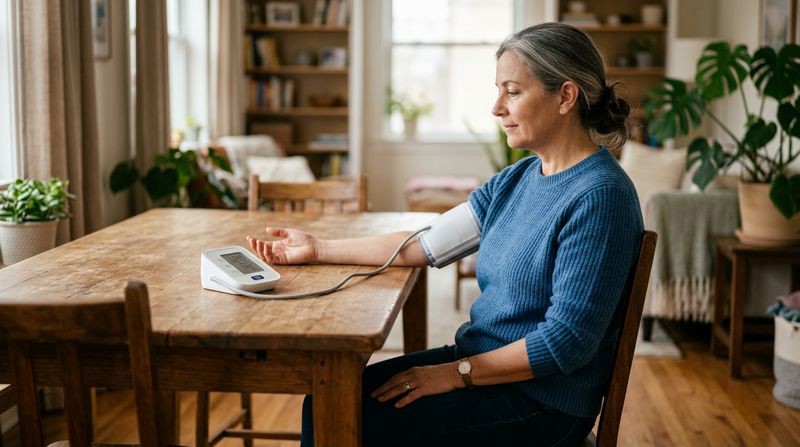
Measuring blood pressure: These three mistakes distort your readings
Millions of people in Germany suffer from high blood pressure – yet many are unaware of it, or receive no treatment or the wrong treatment due to inaccurate readings. A physician identifies three everyday but frequently underestimated measurement errors that can occur even with disciplined self-monitoring at home.
Timing makes the difference
Anyone who measures their blood pressure shortly after waking up or right after taking medication risks distorted readings. It is recommended to wait at least two hours after waking to avoid the natural morning blood pressure rise, and to always take the measurement before taking any medication.
Posture as an underestimated error factor
Sitting position also plays a crucial role: the back should be supported, the legs should not be crossed, and the arm should rest at table height – roughly at heart level. Studies show just how significant these deviations can be: if the arm rests in the lap instead of on a surface during measurement, the systolic value rises by an average of 3.9 mmHg and the diastolic value by 4.0 mmHg. If the arm hangs freely, the difference is even more pronounced – systolic readings run 6.5 mmHg too high and diastolic readings 4.4 mmHg too high. The German Heart Foundation also emphasizes that the upper arm must be positioned as precisely as possible at heart level, neither raised nor lowered.
Multiple measurements instead of just one
The third critical mistake is relying on a single measurement. Three measurements at one-minute intervals are recommended, with the first reading always discarded, as it is often skewed by initial nervousness. Complete silence should also be maintained throughout the measurement – talking or moving during the process can further distort the readings.
Why this matters so much
These seemingly small mistakes have major consequences: they can determine whether a blood pressure reading is classified as normal or in need of treatment. Experts such as the German Hypertension League point out that deviations of 5 to 30 mmHg can result purely from measurement errors – enough to delay necessary treatment or trigger unnecessary therapy.
Source: FOCUS online, "According to a physician, three simple measurement errors distort blood pressure readings – many people are therefore treated incorrectly or not at all" (July 24, 2026)
Note: This article is for general informational purposes
only and does not replace medical advice.
For continuous blood pressure monitoring, we recommend the following product: Hingmed 24-Hour Long-Term Blood Pressure Monitor
